StageSelect Community's Game Awards Predictions Defy Wisdom of Crowds
ByRoberta Williams
The conventional notion that large groups collectively possess superior insight, often termed "the wisdom of crowds," is being challenged in the realm of video game awards predictions. While expansive prediction markets typically rely on aggregated data from numerous participants, a burgeoning platform named StageSelect has demonstrated that a smaller, deeply committed community can achieve astonishingly precise forecasts. This website, launched by a college student, has quickly cultivated a dedicated following of a few hundred users. Their collective predictions for The Game Awards nominees proved exceptionally accurate, even surpassing the performance of much larger, financially-driven prediction platforms. This phenomenon suggests that genuine passion and in-depth knowledge among a niche group might be a more potent predictor of outcomes than the broad, often more detached, consensus of a wider audience. The remarkable success of StageSelect prompts a re-evaluation of how predictive accuracy is achieved, highlighting the value of expertise and genuine engagement over sheer numerical scale.
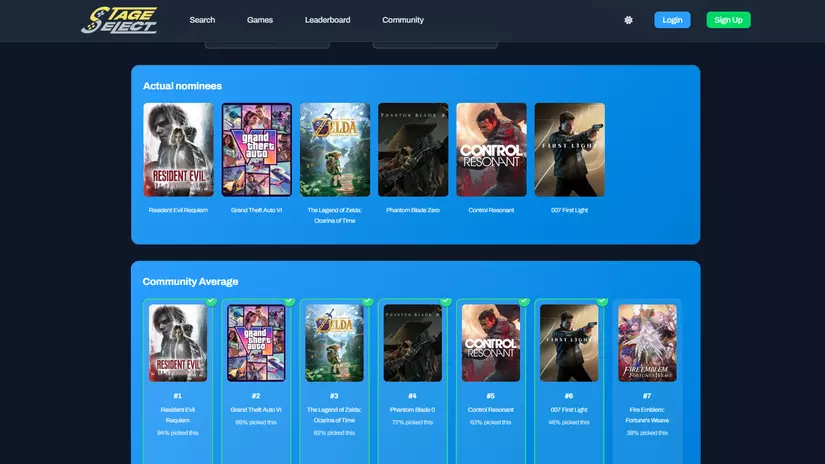
StageSelect emerged from a personal project initiated by CyanLimes, a university student, who sought to create a specialized platform for forecasting video game awards, akin to Gold Derby for film. What began as a simple endeavor for friends quickly evolved into a site attracting between 200 and 300 active users. Ahead of The Game Awards nomination announcements on November 17th, this modest community meticulously submitted their predictions across various categories. The results were astounding: StageSelect users flawlessly identified all six nominees for the coveted Game of the Year award, a feat that even seasoned observers found challenging. Their predictive prowess extended further, perfectly foreseeing the nominees in four additional categories, including Best Game Direction and Best Role-Playing Game, and missing only a single nominee in eight other divisions. This consistent level of accuracy underscores the profound understanding and dedicated analysis within this compact group of enthusiasts.
In stark contrast to StageSelect's precision, larger, more commercial prediction markets like Kalshi and Polymarket faced significant challenges in their Game Awards forecasts. These platforms, often driven by financial incentives, displayed notable gaps in their predictions, overlooking key contenders such as a remake of The Legend of Zelda: Ocarina of Time entirely. Furthermore, they significantly overestimated the prospects of games like Crimson Desert, placing it among their top Game of the Year candidates. StageSelect's community, however, accurately relegated Crimson Desert to a much lower position, demonstrating a more nuanced and informed perspective. This disparity suggests that the profit-motivated aggregation of information from a broad base might inherently lack the granular insight that passionate specialists bring to the table. The qualitative depth of knowledge appears to outweigh the quantitative breadth of participants in this specific domain.
CyanLimes, the visionary behind StageSelect, attributes his community's predictive success not to any secret algorithm, but to the inherent predictability of The Game Awards' selection patterns and, more importantly, the genuine enthusiasm of its users. He noted that the typical criteria and trends favored by the awards panel become discernibly clear to those who closely follow the industry. For CyanLimes, the platform's primary appeal lies not in financial gain—as it operates without funding or advertisements—but in fostering a space where like-minded individuals can engage in enjoyable discussions about the art they cherish. The act of deciphering the awards' preferences is viewed as a stimulating mental exercise, offering a gateway for enthusiasts to connect over shared gaming experiences and critically analyze the industry's landscape. This intrinsic motivation, centered on love for games rather than profit, seems to be the bedrock of StageSelect's unexpected predictive power.
The compelling performance of StageSelect challenges traditional beliefs regarding collective intelligence, particularly in specialized fields. It suggests that when it comes to niche areas like video game awards, a well-informed and passionately engaged smaller audience can often yield more precise insights than the statistically larger but potentially less invested general crowd. This outcome hints at a significant interplay between dedication, specialized knowledge, and predictive accuracy. As the gaming world anticipates the final results of The Game Awards, StageSelect's journey highlights an intriguing model where genuine connoisseurship fosters a superior ability to anticipate industry recognition, proving that sometimes, deep understanding triumphs over sheer numbers.
About the author
Roberta Williams
Pioneer of graphic adventure games, co-founder of Sierra On-Line, and creator of "King's Quest."