"The Spiral" Movie Review: A Chilling Italian Tale of Sacrifices and Social Satire
ByChimamanda Ngozi Adichie
Paolo Strippoli's latest cinematic offering, 'The Spiral' (L'Estranea), emerges as a potent psychological thriller, expertly intertwining elements of the supernatural with incisive social critique. This film, celebrated at the Venice Film Festival, captivates through its exploration of a Bari housewife's harrowing choices, driven by a desperate desire to safeguard her family's perceived perfection. It's a narrative that peels back the layers of bourgeois Italian society, revealing a dark undercurrent of vanity and the unsettling lengths individuals will go to maintain appearances, even if it means forging a pact with enigmatic forces.
Strippoli, known for his dark thrillers like 'Flowing' and 'The Holy Boy,' continues to hone his craft, delivering a third feature that delves into the sanctity of the Italian family unit. The film meticulously dissects the panic that arises when this outwardly flawless facade is threatened. Although its conclusion ventures into apocalyptic territory, the portrayal of upper-class complacency ripe for a downfall is undeniably captivating. The script, co-written with Salvatore de Chirico, subtly addresses the absurdity of a status-obsessed parent's terror at the prospect of a child with imperfections, carefully framing these anxieties within the guise of genuine parental concern for their offspring's welfare and predetermined success.
The story kicks off with Anna, portrayed by Jasmine Trinca, arriving agitatedly in Rome at her estranged daughter Alice's (Romana Maggiora Hergano) apartment amidst a fierce thunderstorm. Alice, a theatrical costume designer, implicitly signals her mother's discomfort with her sexuality through the rushed departure of her female 'director.' Anna, wasting no time, reveals a profound family secret, disclosing that everything Alice believed about their lineage is built on a falsehood, a revelation necessitated by dire circumstances that unfold across four chapters: 'The Daughter,' 'The Son,' 'The Father,' and 'The Mother.' These segments chronologically traverse Anna's increasingly frantic recollections over the past quarter-century.
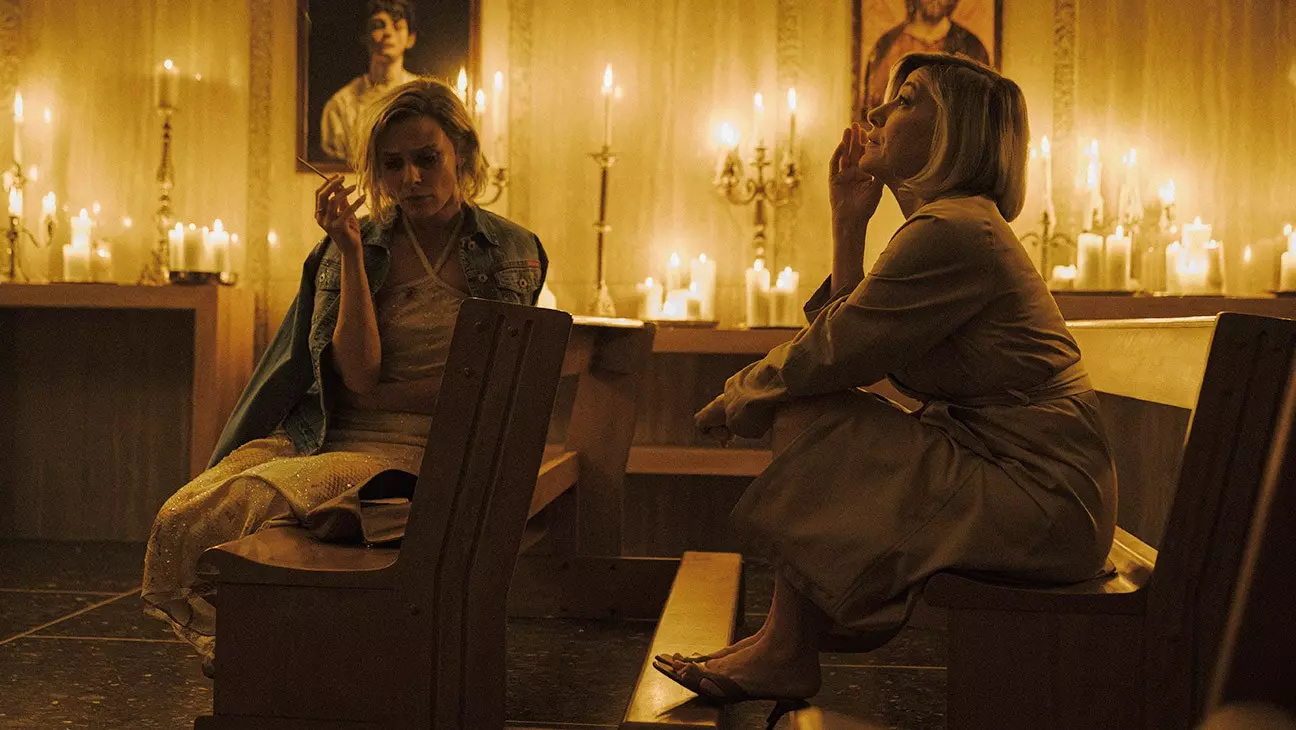
The family's misfortunes trace back to 1999, shortly after their move into a lavish Bari villa. This opulent residence, funded by the profits from Anna’s grandfather's once-tailoring business, now a chic boutique, becomes the backdrop for an unexpected crisis. During a garden party, young Alice is gravely injured by the family's bull terrier, leading to a potential leg amputation. In her despair, Anna encounters a mysterious woman (Valeria Bruni Tedeschi) in the hospital chapel. This enigmatic figure, with her impeccably styled hair and expensive demeanor, offers a chilling bargain: Alice can be saved, but at the cost of another child's health. Bruni Tedeschi's performance as the shrewd, almost malevolent stranger is a highlight, infusing the narrative with a darkly comedic edge as she manipulates Anna with sardonic contempt. The intense dynamic between Trinca and Bruni Tedeschi elevates the film, their exchanges crackling with a psychosexual frisson that adds another layer of intrigue.
As the stranger's demands become more severe, the family's struggles mount, including financial woes. The film skillfully oscillates between Anna and Alice in Rome, with Alice deeply resentful and convinced her mother's tale is merely a fantastical delusion born of self-absorption. This narrative, a sharp twist on the "eat-the-rich" thriller genre, masterfully explores the exorbitant price of a vainglorious pursuit of perfection. Director Paolo Strippoli and cinematographer Cristiano Di Nicola employ striking visuals, characterized by strong compositions and disorienting camera angles, complemented by Quentin Collette’s turbulent sound design and Robin Coudert’s tense synth scores, enhancing the film's atmospheric horror. While a U.S. remake seems probable, the original 'The Spiral' is a worthwhile watch, offering a unique blend of atmospheric horror and sharp societal commentary that resonates beyond its Italian roots.
About the author
Chimamanda Ngozi Adichie
Acclaimed novelist ("Americanah") whose essays and talks offer sharp critiques of culture and feminism.