Nvidia's DLSS 4.5 Ray Reconstruction: A Leap in Path Tracing Fidelity
ByReiner Knizia
Nvidia has unveiled its latest innovation, DLSS 4.5 Ray Reconstruction (RR), a feature specifically engineered to tackle the prevalent visual inconsistencies in ray-traced and path-traced games. While these advanced lighting techniques offer unparalleled realism, they often introduce distracting visual anomalies, particularly during motion. The new DLSS 4.5 RR seeks to alleviate these issues by refining the denoising process, which is crucial for transforming raw, low-fidelity ray-traced images into polished, lifelike frames.
Details of Nvidia's DLSS 4.5 Ray Reconstruction Enhancement
The core challenge in real-time ray tracing lies in its immense computational cost. Even with modern GPUs, tracing every single light ray in a scene remains prohibitively expensive. Consequently, games rely on sampling a limited number of rays and then employing denoisers to fill in the missing visual information. Previous denoisers, while effective for static scenes, struggled with moving elements, leading to noticeable artifacting and a loss of texture detail.
Nvidia’s initial Ray Reconstruction technology addressed this by integrating an AI-powered denoiser with its upscaling models, aiming for more accurate pixel generation. Now, DLSS 4.5 RR takes this a step further by incorporating the sharper, second-generation Transformer model first introduced with DLSS 4.5 Super Resolution in January. This update is particularly crucial because, even with the improved Super Resolution, the Ray Reconstruction component previously still utilized the older model, perpetuating visual glitches.
The new DLSS 4.5 RR boasts four key enhancements:
Efficient Denoiser: The new model significantly boosts computational capability by 35% and processes 20% more parameters, all while maintaining performance levels similar to its predecessor.
Enhanced Super Resolution: Building on the advancements of DLSS 4.5 Super Resolution, this model offers deeper spatial awareness within every scene, intelligently leveraging game engine pixel sampling and motion data. The result is superior lighting accuracy, improved temporal stability, and clearer motion in ray-traced and path-traced content.
Expanded Training Dataset: Trained on a substantially larger dataset, the new model demonstrates enhanced image reconstruction capabilities. This advanced intelligence allows the model to more accurately select engine data for scene reconstruction, bringing it closer to the original visual truth.
Finer Developer Control: Developers now have greater control over temporal accumulation, enabling precise tuning of the model's response for even better image quality.
This upgraded feature is available now and can be activated through the Nvidia App. Users simply need to select a game, navigate to 'DLSS Override - Model Presets', and choose 'Preset F' from the 'Ray Reconstruction' dropdown menu.
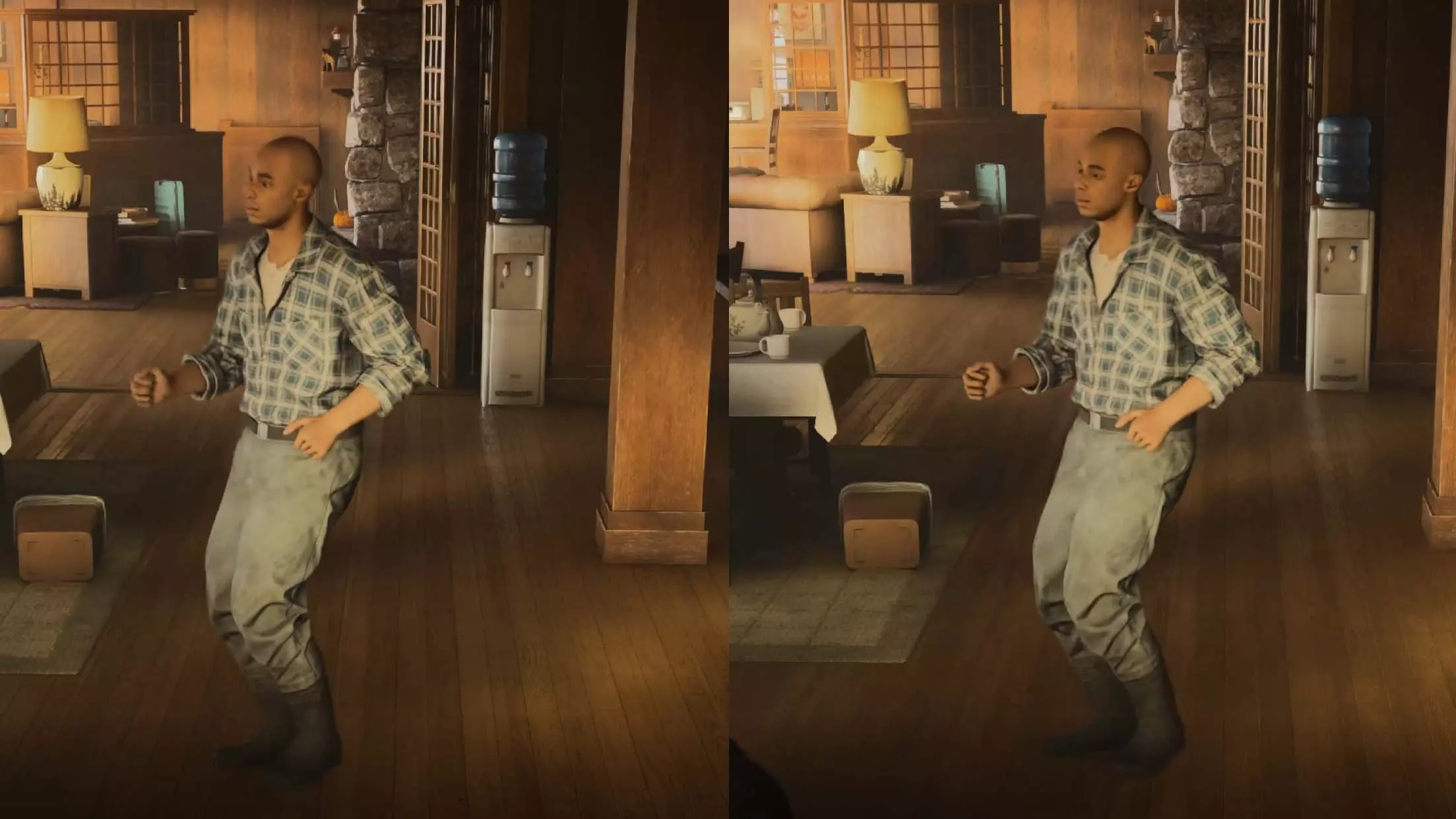
Notable titles benefiting from this update include Alan Wake 2, Cyberpunk 2077, and Resident Evil Requiem, among others. In Resident Evil Requiem, for instance, comparisons show a dramatic reduction in shimmering textures, particularly evident on surfaces like cars in rainy scenes. Similarly, in Cyberpunk 2077, the new RR model eliminates the 'after-image' effect on the ground as the camera moves, and textures in areas like underpasses resolve much more quickly and clearly. Even in Alan Wake 2, where artistic blur might lend itself to the game's atmosphere, the dancing character's movement now appears significantly smoother, with artifacts around the feet almost entirely removed, alongside a noticeable improvement in background detail.
While perfect visual fidelity in path tracing remains an ongoing pursuit, DLSS 4.5 Ray Reconstruction represents a significant step forward. The improvements, though sometimes subtle, collectively contribute to a more stable and detailed gaming experience. Importantly, this feature is compatible with all generations of GeForce RTX GPUs and does not impose a heavier performance burden than its previous iteration. However, older RTX generations may experience a slightly greater impact on system performance compared to the newer RTX 50-series.
The introduction of DLSS 4.5 Ray Reconstruction highlights Nvidia's commitment to pushing the boundaries of real-time rendering. This technology not only enhances the visual quality of current ray-traced games but also sets a new standard for future developments. As gaming hardware continues to evolve, coupled with sophisticated AI modeling, the dream of truly photorealistic game worlds becomes an increasingly tangible reality. This innovation offers a compelling glimpse into the future of immersive gaming graphics, addressing long-standing visual challenges and delivering a refined experience for players.
About the author
Reiner Knizia
Prolific and award-winning board game designer with a PhD in mathematics, known for elegant game mechanics.