Mazda and Toyota's U.S. Factory Achieves One Million Vehicle Milestone, Eyes Expansion
ByAkira Maruta
In a remarkable demonstration of resilience and strategic collaboration, the joint manufacturing facility of Mazda and Toyota in Huntsville, Alabama, has officially celebrated the production of its one millionth crossover. This significant achievement underscores the factory's swift ascent to prominence within the automotive industry, defying the initial hurdles presented by a global pandemic. The sustained demand for their jointly produced vehicles has spurred both automotive giants to explore further expansion opportunities, potentially ushering in a new phase of growth for their alliance.
Milestone Reached in Huntsville: A Closer Look at the Mazda/Toyota Partnership
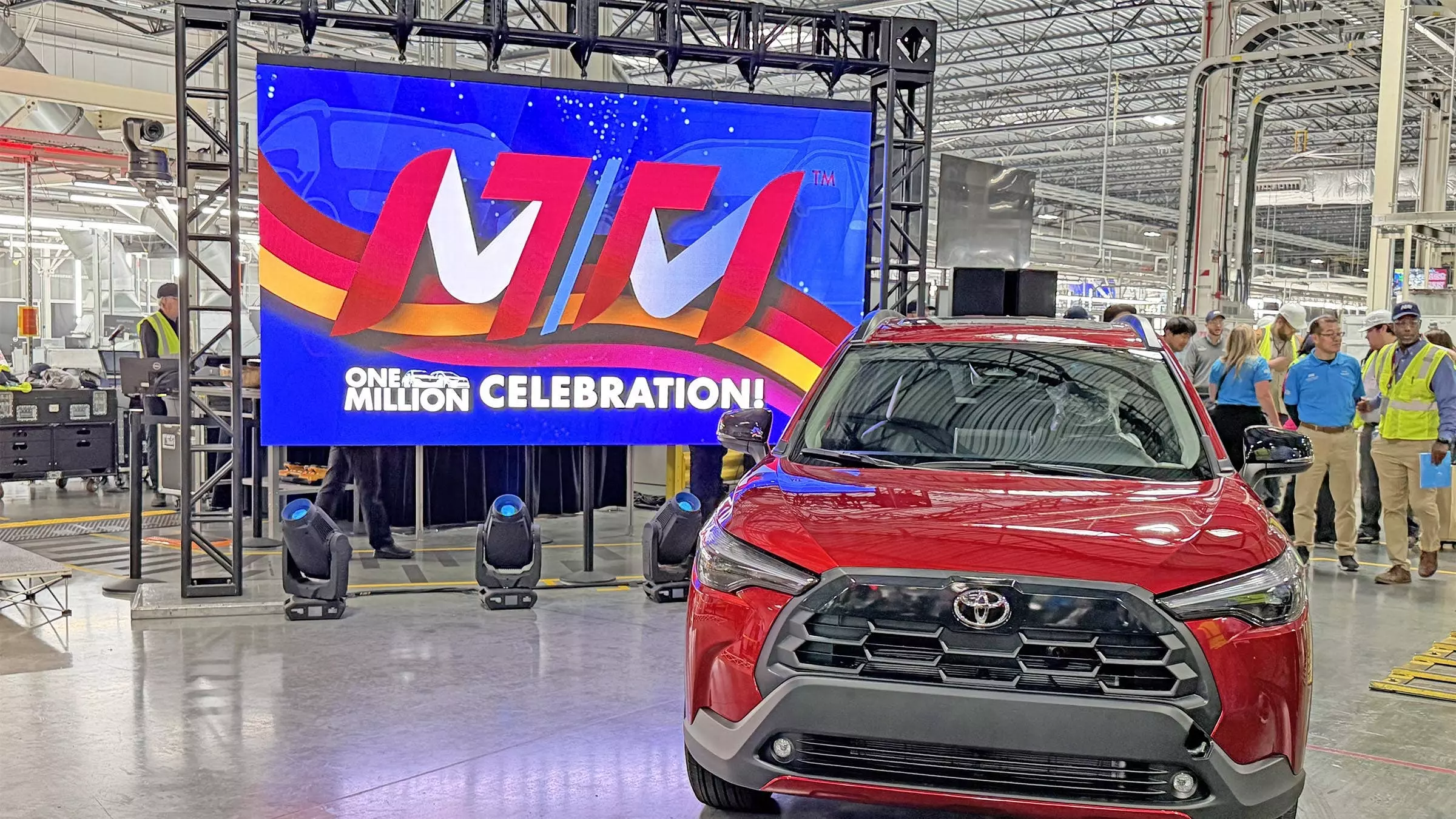
On a recent Wednesday morning, the Mazda Toyota Manufacturing (MTM) facility in Huntsville, Alabama, buzzed with excitement as a gathering of distinguished guests witnessed the unveiling of two radiant Soul Red crossovers: a Mazda CX-50 and a Toyota Corolla Cross. This event marked the historic production of the one millionth vehicle to depart the assembly lines of the MTM operation. While officials artfully refrained from specifying which vehicle claimed the exact milestone, allowing both brands to share in the glory, the real story lay in the factory's impressive pace of growth and successful navigation of adversity.
Established with a substantial investment of $2.3 billion, the facility commenced groundbreaking in 2018. The onset of the COVID-19 pandemic presented unforeseen obstacles, threatening to stall operations. However, through innovative solutions, both companies ensured continuity, facilitating the recruitment of a formidable workforce that now totals 4,500 employees, complemented by an additional 3,500 personnel from various suppliers.
Production initially began with a Toyota Corolla Cross on September 30, 2021, followed by Mazda's CX-50 four months later. The plant is on the cusp of reaching its full two-shift capacity in the coming month, a testament to the surging market demand for both models. This success has prompted discussions about potential major expansions, including the possibility of adding a third shift to further increase output.
Toyota boasts a rich history of manufacturing in the U.S., dating back to 1984 with a facility in Fremont, California. Mazda, after a previous joint venture in Flat Rock, Michigan, concluded in 2012, recognized the strategic necessity of a U.S. manufacturing presence. As Mark Brazeal, MTM's Vice President of Administration and Quality, explained, both companies found compelling reasons to forge this 50/50 partnership. Despite the complexities of merging distinct corporate cultures and accommodating varied design and manufacturing processes, the 3.7 million-square-foot plant successfully integrated operations.
Vehicles begin their journey together in the stamping plant before transitioning to separate assembly lines: the Corolla Cross on the "Apollo" line and the CX-50 on the "Discovery" line, names chosen to honor Huntsville's profound connection to NASA's space endeavors. This thoughtful naming convention prevents the factory from appearing as two disparate halves. Initially, production prioritized quality over sheer volume, a strategy further complicated by the integration of hybrid versions of both vehicles. Nevertheless, the plant is now mere weeks away from achieving its rated annual capacity of 300,000 vehicles, evenly split between the two brands, as confirmed by Rhonda Gilyard, MTM's Vice President of Manufacturing.
Future Outlook: Propelling Growth and Strategic Advantages
While specific future plans remain under wraps, the strong market reception for the CX-50 and Corolla Cross clearly indicates a fertile ground for enhanced production. Tom Donnelly, Mazda's U.S. CEO, revealed that the CX-50 has ascended to become Mazda's second best-selling model. Industry insiders suggest that a third shift could provide an immediate boost to production, but this may be merely the beginning. Brazeal affirmed the plant's potential for expansion, highlighting ample undeveloped land on the Huntsville campus, explicitly designed for future growth.
Toyota has already articulated its intention to significantly bolster U.S. production, with a pledged $10 billion investment in the country. While a new plant could be an option, much of this capital is earmarked for enhancing existing facilities. For Mazda, despite its more modest financial resources, the aspiration for growth is equally strong. Having delivered 410,346 vehicles in 2025, the Hiroshima-based automaker aims to reach 500,000 units in the near future. Both companies perceive substantial benefits in localized production, particularly in navigating trade policies, such as the tariffs previously imposed on Japanese automotive imports. Consequently, expanding the MTM joint venture stands out as a high-priority consideration for both partners, promising continued success and innovation.
The success story of the Mazda Toyota Manufacturing plant in Huntsville, Alabama, is a powerful illustration of what can be achieved through strategic collaboration, even in the face of significant global challenges. It showcases the ability of established automotive giants to adapt, innovate, and expand their footprints to meet evolving market demands. From a journalist's perspective, this venture highlights the increasing trend of international partnerships in the automotive sector, driven by shared goals of efficiency, localized production, and market penetration. The MTM plant's rapid ramp-up, from overcoming a pandemic-induced slowdown to nearing full production capacity, serves as an inspiring example of industrial resilience. Furthermore, the deliberate choice to name their assembly lines 'Apollo' and 'Discovery' not only pays homage to Huntsville's rich space exploration history but also symbolizes the pioneering spirit inherent in this joint venture. This initiative will likely influence future manufacturing strategies across the industry, demonstrating the benefits of shared resources and expertise in creating a robust and adaptable production ecosystem. It makes me wonder if similar collaborations will become more commonplace as manufacturers navigate complex global supply chains and competitive markets.
About the author
Akira Maruta
Fictional representative of journalists deeply knowledgeable about JDM (Japanese Domestic Market) tuning and technology.