Levan Koguashvili's 'Guria' Offers a Humorous Look at 90s Georgia at Venice Film Festival
ByRicky Gervais
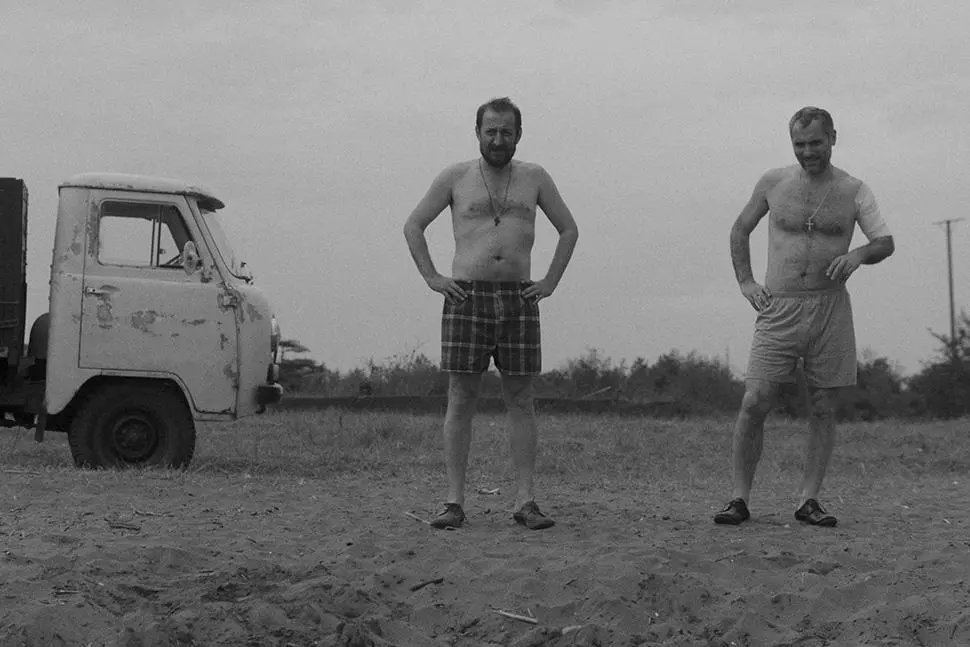
Filmmaker Levan Koguashvili’s latest work, “Guria,” is set to make its global debut at the Venice Film Festival. This tragicomic feature, presented in black and white, transports viewers to Georgia in the 1990s, offering a poignant yet humorous exploration of life, love, and the pursuit of a fair deal for hazelnuts in the unique Guria region.
Journey Through Laughter and Hardship: “Guria” Premieres in Venice
A Widower's Quest in Post-Soviet Guria
Koguashvili's film "Guria" will have its worldwide premiere in the Venice Spotlight section. This cinematic piece is a black-and-white tragicomedy, set in Georgia's western Guria region. It chronicles the journey of Zuriko, a 45-year-old farmer and widower, as he endeavors to find both companionship and a reasonable price for his hazelnut harvest.
International Collaboration Fuels "Guria" Production
The creation of "Guria" was a collaborative effort involving several countries, including Kino Iberica from Georgia, Cineworx from Switzerland, Tarantula from Luxembourg, and ArtFest from Bulgaria. Additional backing came from diverse sources like Turkey's Ministry of Culture and Tourism, Norway's SoRFond Film Fund, and Saudi Arabia's Red Sea Fund, highlighting the film's broad international appeal and support.
A Director's Continued Success and Vision
This film marks Levan Koguashvili's fourth feature, building on a successful career that includes award-winning films like "Street Days" (2010), "Blind Dates" (2013), and "Brighton 4th" (2021). "Guria" was co-written by Koguashvili and his long-term collaborator and former professor, Boris Frumin, showcasing a enduring partnership in storytelling.
The Genesis of a Georgian Narrative
Koguashvili shared insights into the making of "Guria" during a discussion in Venice. He explained that the extensive international co-production model was primarily driven by financing needs, necessitating contributions from various global partners. Despite the complexities of managing such a diverse team, the collaboration fostered an international crew, bringing together talent from different countries like Switzerland for sound and Luxembourg for editing, which he found to be a rewarding experience. The director was particularly gratified by the global interest in his story of love and friendship set in Guria, with Saudi Arabian support joining late in the process after the film won awards at the Red Sea industry park.
The Dynamics of a Creative Partnership
Discussing his collaborative writing process with Boris Frumin, Koguashvili revealed that their partnership began when Frumin was his professor at NYU. Despite their age difference, they formed a friendship and a professional bond. Koguashvili typically provides the raw material—Georgian settings, life situations, and characters—while Frumin excels at structuring these elements into a cohesive narrative, emphasizing the importance of strong, impactful scenes.
Capturing the Essence of 1990s Georgian Provinces
Koguashvili chose 1990s Guria as the film's backdrop due to his appreciation for the authentic character of Georgian provinces, which he believes retain a distinct flavor unlike increasingly uniform big cities. Inspired by a melancholic book titled "Gurian Diaries," which depicted the poverty and humor of the era without a concrete plot, Koguashvili collaborated with the author to gather material in Guria for several months. This immersive experience, combined with Frumin's structural expertise, quickly led to the development of the film's plot.
Blending Hardship with Humor: Koguashvili's Signature Style
Koguashvili's filmmaking often navigates the space between adversity and humor, a reflection of his perspective on life's multi-dimensional nature. He believes that integrating irony and comedy into tragic narratives does not diminish their gravity but rather humanizes them, making them more accessible and imbued with a lyrical lightness. This approach also serves to counteract stereotypes, such as the common depiction of post-Soviet 90s as uniformly grim, showcasing instead the unique blend of difficulty, absurdity, and charm inherent in the Georgian character and that period.
The Narrative Power of Georgian Polyphonic Singing
The film ingeniously incorporates Georgian folk singing as a crucial narrative device. Koguashvili highlights Georgia's rich tradition of polyphonic singing, often featuring three to seven voices, creating complex, improvisational music. Growing up with traditional Georgian dinners, or supra, where singing was a central activity, deeply influenced him. For "Guria," he collaborated with a composer from the region to adapt this tradition, opting for a more intimate, single-voice approach that still captured the essence of Georgian music.
About the author
Ricky Gervais
Comedian, writer, and actor who created "The Office" and writes provocatively on comedy and society.