Gary Larson's Prehistoric Wit: The Funniest Caveman Inventions in The Far Side
ByMark Rosewater
Gary Larson's seminal comic strip, "The Far Side," carved a distinct niche in the landscape of newspaper cartoons by eschewing a fixed ensemble of characters in favor of a constantly evolving parade of scenarios and personalities. This innovative approach allowed Larson unparalleled freedom to explore a vast array of comedic themes, often centered around animals, scientists, and prehistoric humans. Among these, his portrayal of cavemen proved particularly fertile ground for humor, frequently casting them as bumbling, well-meaning ancestors grappling with the fundamental concepts of civilization. Larson masterfully mined comedic gold from these primitive settings, especially when depicting early human attempts at innovation. He frequently returned to themes like the discovery of fire and the invention of the wheel, but his most memorable caveman gags often involved absurd, anachronistic, or hilariously impractical inventions and societal constructs. These vignettes brilliantly juxtaposed the primitive world with modern concepts, highlighting the inherent silliness in the origins of everyday objects and ideas. The enduring appeal of these comics lies in their clever subversion of historical progress, presenting a delightfully skewed vision of humanity's earliest endeavors.
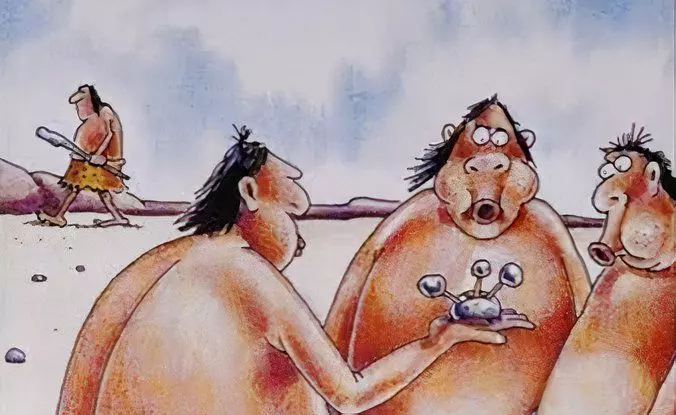
A prime example of Larson's knack for turning familiar concepts on their head is the "Swiss Army Rock." This prehistoric precursor to the versatile multitool humorously imagines a rock containing smaller, equally useless rocks. It perfectly encapsulates the strip's signature absurdity, presenting an invention that is both brilliantly conceived and utterly pointless, satirizing the very notion of utility. Another gem is the depiction of the "first symphony." Larson humorously illustrates a group of cavemen, surprisingly equipped with instruments resembling modern ones, performing what is declared as the inaugural symphony—a single, drawn-out note. This comic strips away the grandeur of orchestral music to its most primitive, laughably simplistic form, showcasing the minimalist origins of complex artistic expressions.
Larson also explored social dynamics in the Stone Age. One notable comic portrays early peer pressure, with a group of rough-looking cavemen urging a more innocent-looking one to partake in some questionable activity. This vignette cleverly riffs on the D.A.R.E. campaigns of later eras, suggesting that the struggle against negative influences is as ancient as humanity itself, begging for a more expansive narrative on prehistoric moral dilemmas. The evolution of games also received Larson's unique treatment. His take on the origin of checkers involves cavemen playing on a board with only two squares. This brilliantly simple concept exaggerates the developmental stages of recreational activities, reducing a strategy game to its most rudimentary and inherently uninteresting form, yet still finding humor in the early human desire for organized play.
The scientific realm wasn't spared Larson's comedic lens. He envisioned the first microscopes as gigantic contraptions, requiring cavemen to physically peer into massive structures to observe the minuscule. This visual gag humorously inverts our understanding of technological miniaturization, proposing an initial phase where tools designed for small-scale observation were themselves colossal, highlighting the early, clunky steps of scientific discovery. Larson's creativity extended to early modes of transport. One particularly memorable strip shows a caveman using another caveman's head as a plow, pushing him along to create a surprisingly long, unbroken furrow in the dirt. The sheer duration of the dragged journey, indicated by the extensive trail, adds a layer of dark humor to this brutal and inefficient method of ground-clearing or perhaps rudimentary travel.
In a masterstroke of reverse logic, Larson presented a comic where the need for a car preceded the invention of the wheel. A caveman is shown proudly displaying a fully formed automobile, only to realize he still needs to invent a round object to make it move. This serves as a brilliant commentary on the often non-linear and illogical path of innovation, proving that necessity doesn't always dictate a logical sequence of inventions. Further exploring the wheel, another comic depicts a caveman attempting to ride a single, large stone wheel like a unicycle. This image perfectly captures the dangerous and often misguided early experiments with new technologies. The potential for catastrophic failure, especially on a downhill slope, makes the humor both obvious and enduring, showcasing the trial-and-error nature of human progress.
Even everyday professions found their prehistoric counterparts. Larson humorously imagined caveman plumbers facing the same perplexing issues as their modern descendants, wielding an oversized wrench with an air of bewilderment. This comic suggests that some societal roles and their associated frustrations are timeless, hinting at a deep history of clogged pipes and the perennial need for specialized, if somewhat clueless, assistance. Perhaps one of the most hilariously dangerous early inventions portrayed is the "early piñatas." This comic depicts blindfolded cavemen swinging sticks at a piñata filled not with candy, but with rocks. The dark comedic genius lies in transforming a festive activity into a potentially lethal game, underscoring Larson's ability to inject peril and absurdity into the most unexpected scenarios, making the "prize" a truly dubious reward.
These selected works from "The Far Side" collectively demonstrate Gary Larson's unparalleled talent for blending observational humor with surreal imagination, particularly when it came to his prehistoric subjects. Through these caveman-centric cartoons, he not only satirized the human condition but also playfully re-imagined the dawn of civilization with a distinctly absurdist twist. Each panel, whether it featured a ludicrous early tool or a clumsy attempt at societal organization, served as a concise, witty commentary on ingenuity, folly, and the enduring human spirit of invention, always delivered with Larson's signature blend of intellect and silliness. His unique vision continues to resonate, reminding us that even the most profound concepts can be viewed through a delightfully bizarre lens.
About the author
Mark Rosewater
Head designer for "Magic: The Gathering" and author of long-running insights on game design.