Gary Larson's Enduring Genius: Five Iconic 'The Far Side' Cartoons That Defined His Style
ByReiner Knizia
Gary Larson's "The Far Side," which graced newspapers from 1980 to 1995, captivated audiences with its unique brand of humor, ultimately appearing in nearly 2,000 publications. Larson's unparalleled talent is evident in the remarkable breadth of his work, which effortlessly navigated between profound wit and pure absurdity. His strips often ventured into the surreal, demonstrating a mastery of both clever wordplay and impactful visual storytelling. This enduring appeal stems from Larson's ability to consistently surprise and entertain, making each cartoon a testament to his creative brilliance. The following examples highlight the multifaceted nature of his genius.
Larson's innovative comedic style was not confined to a single approach; he expertly blended different forms of humor to create a truly distinctive body of work. From the overtly foolish to the subtly intelligent, his cartoons consistently showcased a knack for turning ordinary situations into extraordinary comedic gold. His ability to distill complex ideas or common phrases into a single panel, often with unexpected twists, cemented his status as a comedic icon. The enduring legacy of "The Far Side" is a testament to Larson's boundless imagination and his capacity to connect with a diverse audience through universal themes of silliness, observation, and subtle societal commentary.
The Spectrum of Larson's Humor: From Absurdity to Subtle Wit
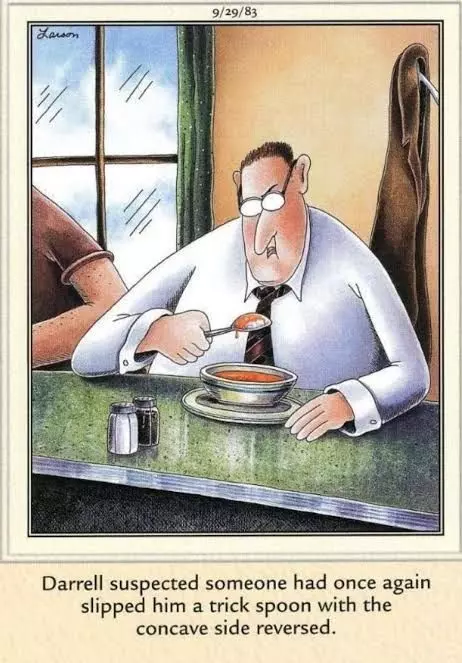
Gary Larson's comedic brilliance in "The Far Side" was frequently showcased through his portrayal of remarkably absurd situations and characters. He had a particular knack for depicting intellectual figures, such as scientists, in hilariously foolish scenarios, or illustrating large groups engaged in irrational behaviors for trivial reasons. A prime example of this was a 1983 comic strip featuring a man so utterly clueless that he couldn't even manage to hold a spoon correctly. This kind of exaggerated stupidity, masterfully conceived and executed, highlights Larson's genius in finding humor in the most unexpected and seemingly unintelligent human actions.
Conversely, Larson also demonstrated a remarkable talent for crafting subtle and intellectually stimulating humor. Many of his comic strips contained clever allusions to classic literary works, such as Mary Shelley's "Frankenstein." He held a special fondness for Herman Melville's "Moby Dick," referencing it multiple times, with one notable instance from 1980 depicting Captain Ahab at a bar with an animal rights activist who remarks, "Oh, sure — white whales. … We’ve got plenty of them." This cartoon's effectiveness relied on the reader's pre-existing knowledge of "Moby Dick," including Ahab's iconic appearance and his obsessive pursuit of the white whale, showcasing Larson's ability to engage his audience on a deeper, more referential level, even if some of these nuanced jokes might have occasionally flown over people's heads.
The Ingenuity of Wordplay and Visual Storytelling
Larson's genius often manifested in his ingenious manipulation of common expressions and the creation of visually driven narratives that required no dialogue. The well-known adage "Curiosity killed the cat" was given a fresh and surprising comedic twist in one of his cartoons, where a detective investigates a scene littered with deceased felines, having seemingly succumbed to literal, scientific curiosity. This literal interpretation of an idiom demonstrated Larson's unparalleled ability to transform familiar phrases into unexpected and deeply humorous scenarios, showcasing a truly brilliant mind at play in his creative process.
Furthermore, some of Larson's most memorable cartoons conveyed their humor entirely through imagery, transcending the need for words. A striking example features a role reversal between a dog and a human in a car: the dog is in the driver's seat, while the man eagerly leans out the window, tongue wagging in pure joy. This simple yet profound visual gag effortlessly combines elements of cleverness, silliness, and unexpected insight, encapsulating the diverse comedic range that made "The Far Side" and its creator, Gary Larson, a true master of the comic strip art form. This blend of visual storytelling and wordplay solidified his legacy as a unique and influential figure in humor.
About the author
Reiner Knizia
Prolific and award-winning board game designer with a PhD in mathematics, known for elegant game mechanics.