The Enduring Wisdom of Captain Picard's Most Profound Quote
ByRichard Garfield
Among Star Trek enthusiasts, discussions frequently revolve around the most exceptional captain in the franchise's extensive history. While some gravitate towards James T. Kirk's bravado or Benjamin Sisko's resolve, it is often Jean-Luc Picard who emerges as the definitive choice. His character embodies the highest ideals of Starfleet: intellect, diplomatic skill, insatiable curiosity, and profound compassion. This deep admiration for Picard is perhaps best crystallized not in his iconic commands, but in a quiet, yet profoundly impactful statement from one of the series' most celebrated episodes, "The Inner Light."
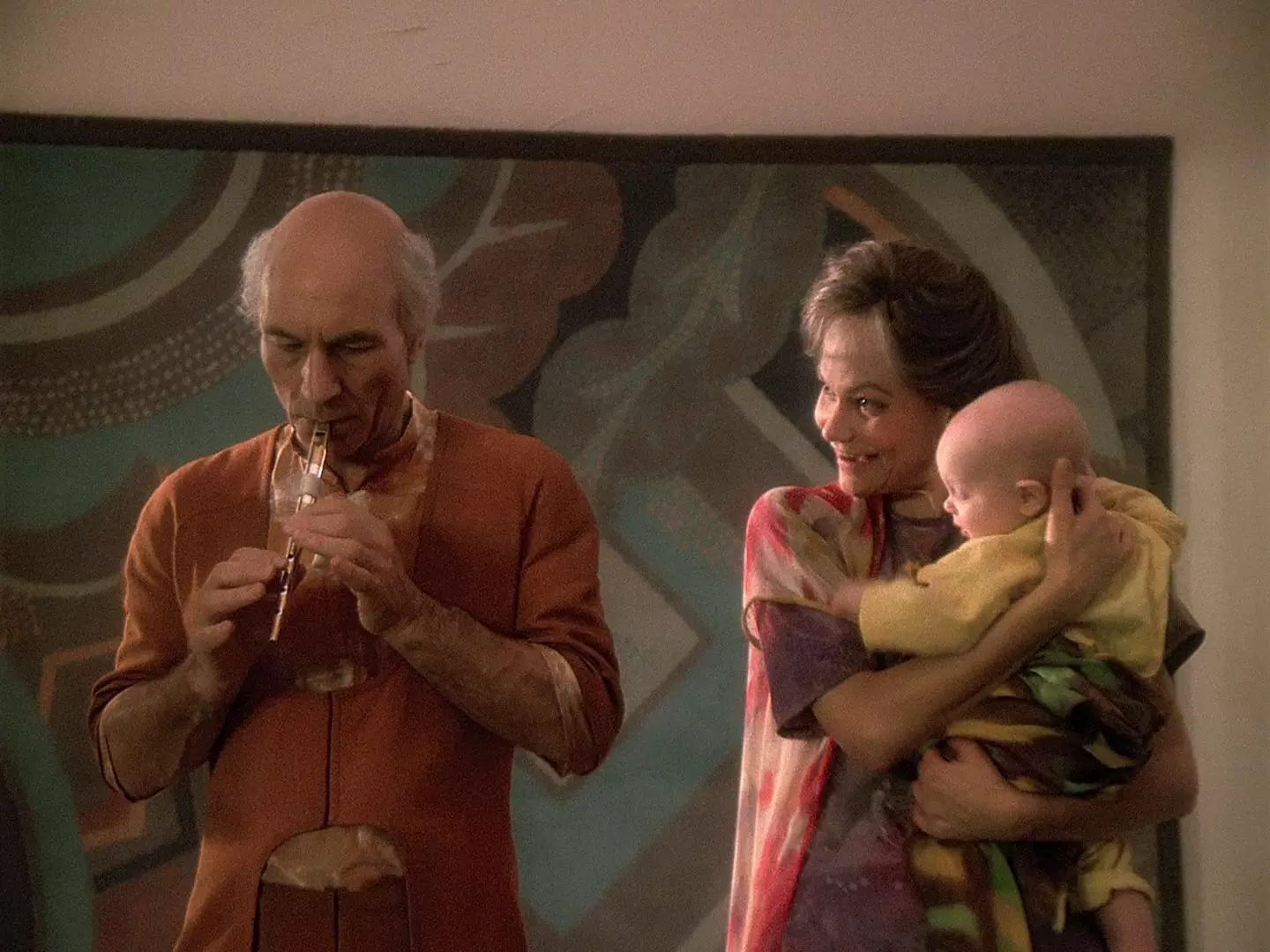
The specific utterance that most powerfully reveals Picard's true nature isn't a directive like "Make it so" or "Engage." Instead, it's a profound reflection shared during a deeply personal experience. In the fifth season's critically acclaimed episode, "The Inner Light," Picard, through an extraordinary encounter, lives out an entire lifetime as Kamin on a distant planet named Kataan. It is as Kamin, not Picard, that he imparts the wisdom, "Seize the time... Live now. Make now always the most precious time. Now will never come again." This declaration resonates far beyond a simple command, offering a glimpse into the very core of the man beneath the Starfleet uniform, highlighting his innate understanding of life's fleeting beauty.
First broadcast on June 1, 1992, "The Inner Light" presents a deceptively simple narrative. While investigating a seemingly uninhabited world, the USS Enterprise encounters an ancient probe that subjects Picard to a powerful energy beam. On the starship, only a brief period, approximately 25 minutes, elapses. However, within Picard's consciousness, he experiences decades as Kamin, an iron weaver on Kataan. He forms a family, witnesses his children's growth, masters the ressikan flute, and slowly comprehends the impending demise of his adopted home world. Upon his return to the Enterprise, Picard carries the weight of a complete existence lived through another's eyes, profoundly altered by the experience.
The poignant quote arises during the twilight of Kamin's life, as he tenderly advises his daughter to cherish every passing moment. On the surface, this counsel serves as an imperative to make the most of a civilization's final days. However, its deeper meaning extends universally: time is the most irreplaceable commodity of all. This episode masterfully showcases Picard not merely as a commanding officer, but as a man capable of deep personal connection and sorrow. The memories of Kataan, and particularly the ressikan flute discovered within the probe, remain with him, serving as a constant reminder that Kataan was not merely a vision, but a genuine home, forever etched in his being.
For seven seasons, "The Next Generation" showcased Jean-Luc Picard's exemplary leadership qualities. Yet, "The Inner Light" introduces the audience to the essence of Jean-Luc Picard as a human being. As Kamin, his worth is not measured by orders issued or crises averted, but by the bonds he forges, the family he nurtures, and the life he constructs. His return to the Enterprise marks not just an acquisition of knowledge about another civilization, but a profound grieving for its loss. He becomes the keeper of an entire people's memories, ensuring their legacy is not forgotten. This pivotal experience solidifies empathy, rather than command, as Picard's defining characteristic. More than any other Star Trek captain, he champions the belief that every culture, every initial contact, and every individual holds valuable lessons. Few encounters could have impacted him more profoundly than experiencing an entire lifetime through another's perspective.
True science fiction, at its core, isn't about clairvoyance, though it sometimes offers prescient insights. Its true purpose is to utilize imaginative worlds to illuminate our own realities. "The Inner Light" achieves this with remarkable efficacy. Its elements – the enigmatic alien probe, the vanished civilization, and the seemingly impossible premise – craft a compelling science fiction narrative. Yet, these serve merely as an invitation. What truly lingers in the mind are Kamin's family, Picard's absorbed memories, and the solitary image of him on the Enterprise, playing the ressikan flute, a symbol of his lived experience. This is why the episode continues to resonate over three decades later and why Star Trek has endured for nearly 60 years. At its best, science fiction doesn't compel us to marvel at technological advancements, but rather to engage in self-reflection. The science fiction framework of Star Trek opens the door, but its profound humanism is what consistently draws us back.
About the author
Richard Garfield
Mathematician and game designer who created "Magic: The Gathering," revolutionizing collectible games.