The Enduring Philosophy and Humor of Calvin and Hobbes
ByReiner Knizia
Discover the profound philosophical currents and brilliant comedic timing embedded within the classic comic strip, "Calvin and Hobbes," a timeless creation by Bill Watterson that continues to resonate with audiences worldwide.
Embrace Life's Absurdities with Laughter and Wisdom
The Philosophical Roots of Calvin and Hobbes Characters
A fascinating detail that could serve you well in a future trivia challenge involves the origins of the names of Calvin and Hobbes' main characters. Bill Watterson drew inspiration from two prominent European thinkers: John Calvin, a theologian known for his controversial ideas on predestination, and Thomas Hobbes, author of the seminal work Leviathan, which laid the groundwork for social contract theory. This intentional naming hints at the deeper intellectual currents flowing beneath the comic's surface.
Exploring the Characters' Philosophical Alignments
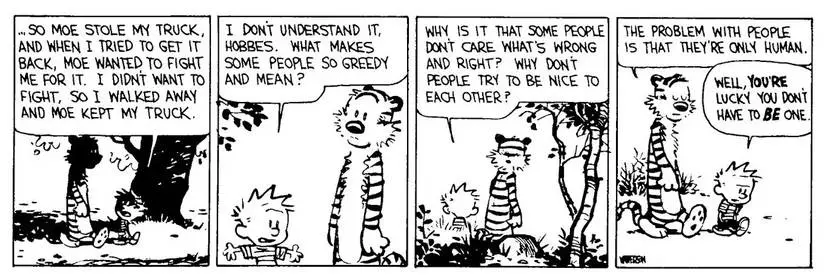
While a direct correlation between the comic strip characters and their philosophical namesakes can be elusive, Calvin often aligns more closely with his namesake's concept of predestination. As a young boy, his life is largely dictated by forces beyond his immediate control, mirroring the idea of a predetermined existence. Hobbes, the tiger, ironically leans towards the "nasty, brutish, and short" state of nature that Thomas Hobbes argued against, preferring a simpler, more primal existence. A common thread between both Hobbeses, as Watterson himself observed, is a shared skepticism toward humanity.
Watterson's Vision: Inventing Life's Meaning
Bill Watterson articulated the core ethos of Calvin and Hobbes in his 1990 commencement address at Kenyon College. He emphasized the challenging yet rewarding endeavor of forging one's own life's meaning. He suggested that grappling with complex philosophical texts, while not directly leading to employment, equips individuals with essential mental tools for navigating life's fundamental questions about truth, purpose, meaning, and redemption. This perspective offers a more insightful lens through which to appreciate the comic strip.
Calvin's Inquisitive Spirit and Hobbes's Simplicity
Rather than portraying characters who consistently embody specific philosophical stances, Calvin and Hobbes is better understood through Calvin's perpetual questioning. He often finds himself bewildered by the world, constantly seeking to understand why things are the way they are. In contrast, Hobbes frequently serves as a voice of straightforwardness, not necessarily possessing all the answers but rather demonstrating a preference for simplicity and avoiding overthinking. His philosophy often boils down to "first thought, best thought."
The Poignancy of Hobbes's One-Sentence Answers
A recurring and beloved aspect of Calvin and Hobbes is the subgenre where Hobbes offers concise yet profound responses to Calvin's complex inquiries. If Bill Watterson were to compile themed collections, "Calvin and Hobbes: The Dialogues" would undoubtedly be a strong candidate. These strips often find their humor in Hobbes's tiger nature, his indifference to human concerns, or his candid assessment of human flaws. However, an exception appears in a notable strip from April 19, 1992.
Creative Freedom and the Evolution of the Comic
This particular strip originated during a period following Watterson's initial sabbatical, when he successfully negotiated greater creative autonomy with his syndicate. This allowed him to design full-color Sunday comics as single, cohesive half-page blocks, moving away from fragmented panels that newspapers could rearrange. While this specific strip is less elaborate than some of his later works, it exemplifies Watterson's newfound freedom to utilize expansive negative space, a luxury rarely afforded to syndicated comic artists.
The Existential Question of Humor
During a tranquil woodland walk, Calvin ponders the curious evolutionary development of a sense of humor. He finds it peculiar that humans possess a physiological reaction to absurdity, finding joy in nonsense, and questions its evolutionary benefit. Hobbes's insightful reply, "I suppose if we couldn't laugh at things that don't make sense, we couldn't react to a lot of life," encapsulates a profound truth. As Hobbes quietly departs, Calvin contemplates whether the remark is amusing or deeply unsettling.
The Enduring Wisdom of Laughter
Hobbes's simple answer, though brief, carries significant weight. It underscores the vital role of humor in coping with life's irrationalities. The alternative—to succumb to screaming, raging, or complete emotional shutdown—is far less desirable. This concept echoes through the works of various artists and writers across generations, including Lord Byron. This particular Calvin and Hobbes strip powerfully revisits this timeless theme, standing as a strong contender for one of the most sagacious observations ever attributed to Hobbes by Watterson.
About the author
Reiner Knizia
Prolific and award-winning board game designer with a PhD in mathematics, known for elegant game mechanics.