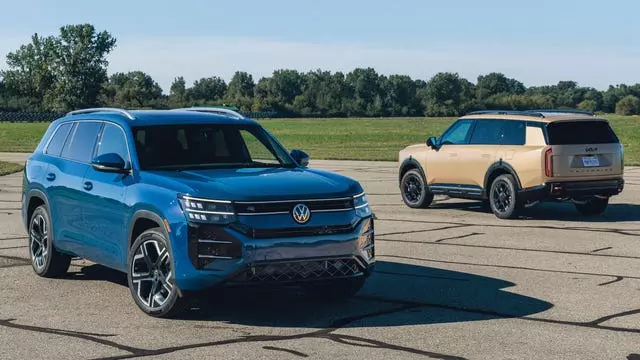
2027 Kia Telluride X-Pro vs. 2027 Volkswagen Atlas SEL Premium: A Head-to-Head Comparison
ByMichele Acquaragia
In the highly competitive market of three-row SUVs, two formidable contenders, the 2027 Kia Telluride X-Pro SX Prestige AWD and the 2027 Volkswagen Atlas SEL Premium R-Line 4Motion, go head-to-head. While the Telluride recently emerged victorious in a broader comparison test, the significantly revamped Atlas presents a fresh challenge. Both models, priced similarly and equipped with comparable turbocharged four-cylinder engines and all-wheel drive, offer a compelling package of features and capabilities for families seeking spacious and well-appointed transportation. This evaluation dives deep into their design, interior amenities, performance, and driving dynamics to determine which vehicle ultimately delivers a superior experience.
These two top-spec family haulers, while sharing many luxurious features like heated/ventilated seating, large infotainment displays, and premium sound systems, reveal subtle yet impactful distinctions. The Telluride boasts a more avant-garde exterior design and a slightly more intuitive infotainment system with physical controls. In contrast, the Atlas offers a more traditional exterior aesthetic, a brighter interior ambiance with unique lighting accents, and a marginally quicker acceleration response. Despite their closely matched dimensions and performance figures, their individual approaches to comfort, user interface, and on-road feel create a nuanced choice for discerning buyers. Ultimately, the Telluride's refined ride and user-friendly cabin gave it a slight edge in this close contest, though the new Atlas proved itself a strong competitor.
Comparing Premium Features and Design
The 2027 Kia Telluride X-Pro SX Prestige AWD and the 2027 Volkswagen Atlas SEL Premium R-Line 4Motion represent the pinnacle of their respective lineups, offering a wealth of advanced features and sophisticated amenities. Both vehicles come equipped with all-wheel drive, heated and ventilated front and second-row seats, extensive infotainment systems, high-quality audio, head-up displays, dual wireless charging, power liftgates, and numerous USB-C ports, ensuring a connected and comfortable journey for all occupants. Despite their feature parity, their exterior designs diverge significantly. The Telluride showcases a bold, modern, and distinctive aesthetic with its sharp lines and prominent front grille, a deliberate departure from its predecessor. Conversely, the Atlas maintains a more conservative and evolutionary design, subtly updating its appearance while retaining familiarity. These differing design philosophies extend to their interiors, where both provide ample space but with distinct ambient experiences and user interfaces, influencing overall driver and passenger satisfaction.
Beyond the fundamental luxury appointments, the two SUVs exhibit nuanced differences that cater to varying preferences. The Telluride integrates its 12.3-inch infotainment display seamlessly with a matching instrument cluster, creating a wide, modern digital landscape. Its system is lauded for being more intuitive, incorporating convenient physical and haptic buttons for essential controls like HVAC and media. The Atlas, while featuring a larger 15.0-inch center screen and a separate 10.3-inch digital instrument cluster, presents a slightly less intuitive user interface, despite recent improvements. In terms of cabin comfort, both offer spacious accommodations capable of seating adults comfortably in all three rows, with cargo capacities also being closely matched, fluctuating slightly depending on seat configuration. However, the Telluride provides a more expansive second-row experience, while the Atlas offers a slightly more comfortable third row. Aesthetically, the Telluride's all-black interior in the X-Pro trim, though plush, can appear somber, whereas the Atlas brightens its cabin with gray-and-black soft trim, Nappa leather, and distinctive backlit perforated swirls on door panels, creating a more vibrant and visually engaging environment, particularly at night.
Performance and Driving Dynamics
When it comes to performance, the 2027 Kia Telluride X-Pro and 2027 Volkswagen Atlas are remarkably similar, both powered by turbocharged four-cylinder engines paired with eight-speed automatic transmissions. The Telluride's 2.5-liter engine produces 274 horsepower, while the Atlas's 2.0-liter engine generates 282 horsepower. Their curb weights are also very close, with the Telluride being only slightly heavier. This translates to nearly identical acceleration figures, with both SUVs reaching 60 mph in the mid-7-second range and completing the quarter-mile within tenths of a second of each other. However, the Atlas demonstrates better fuel efficiency, boasting an EPA combined rating of 23 mpg compared to the Telluride's 19 mpg. Despite the similarities in raw power, their driving experiences differ, particularly in responsiveness and ride quality, which become key factors in distinguishing the two. The Telluride, particularly in its X-Pro trim, prioritizes a smooth and quiet ride, making it an excellent choice for long-distance family travel.
The subtle distinctions in driving dynamics play a crucial role in the overall appeal of these two SUVs. The Volkswagen Atlas exhibits a more athletic and immediate response, feeling livelier off the line and in urban traffic, as confirmed by its quicker 5-to-60 mph rolling start acceleration. Its engine note also possesses a more pronounced edge, contributing to a sportier feel. The Telluride, on the other hand, prioritizes refinement and comfort, offering a softer ride that effectively absorbs road imperfections and a noticeably quieter cabin at highway speeds, registering 67 decibels compared to the Atlas's 69. The Telluride X-Pro's all-terrain tires, while beneficial for light off-roading, compromise cornering grip and braking performance on paved surfaces, leading to lower skidpad figures and longer stopping distances than the Atlas, which, with its all-season tires, demonstrates superior handling and braking capabilities. This difference underscores a divergence in focus: the Telluride leaning towards comfort and subtle ruggedness, while the Atlas emphasizes a more engaging and responsive driving experience, albeit with a firmer ride that can feel less compliant on rougher roads.
About the author
Michele Acquaragia
Fictional representative of the passionate journalists covering high-performance supercars and Italian design.