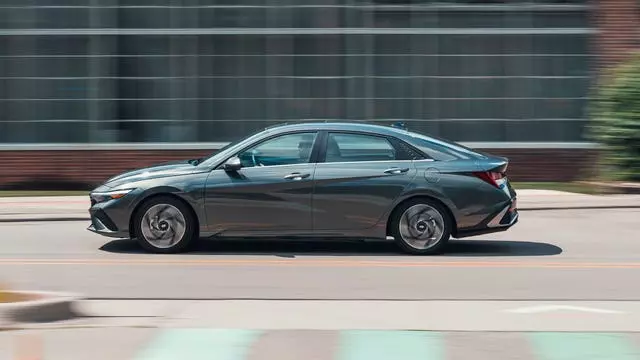
2026 Hyundai Elantra Hybrid: A Value Proposition with Performance Trade-offs
ByLarry Chen
The 2026 Hyundai Elantra Hybrid positions itself as an economical alternative in the compact hybrid sedan market, promising value through lower pricing and a generous array of features. However, a deeper examination reveals that its competitive edge in cost is offset by underperforming powertrain metrics and disappointing real-world fuel efficiency, especially when compared to its key rivals like the Honda Civic Hybrid and Toyota Prius. This review delves into the Elantra Hybrid's strengths and weaknesses, evaluating whether its affordability justifies its performance trade-offs.
Affordability Meets Amenity: The Elantra Hybrid's Value Equation
The Pricing Advantage: Hyundai's Strategy for the Cost-Conscious Buyer
The 2026 Hyundai Elantra Hybrid stands out with its attractive pricing, starting at a lower point than its primary competitors, the Honda Civic Hybrid and Toyota Prius. A base model Elantra Hybrid begins at $26,945, with the Limited test model topping out at $31,295. This compares favorably to the Civic Hybrid's range of $30,590 to $33,590 and the Prius's starting price of $29,845, which can soar to $38,260 for a fully-equipped all-wheel-drive version.
Feature-Rich Interior: Comfort and Technology Despite the Price Point
Despite its budget-friendly price, the Elantra Hybrid Limited test model does not skimp on amenities. It boasts 17-inch alloy wheels, LED taillights, a digital key, heated and ventilated front seats, seat-position memory, Bose audio, and Hyundai's Highway Driving Assist. While the cabin incorporates a notable amount of hard plastics, suggesting a cost-saving measure, the abundance of physical buttons is a welcome feature for many drivers.
Performance Discrepancies: Where the Elantra Hybrid Falls Short
The Elantra Hybrid's value proposition diminishes when its performance figures are put under scrutiny. Its powertrain, comprising a 2.0-liter inline-four engine and an electric motor, generates a modest 139 horsepower. This output trails significantly behind the Civic Hybrid's 200 hp and the Prius's 194 hp, leading to slower acceleration times. The Elantra Hybrid's 0 to 60 mph sprint takes 8.4 seconds, markedly slower than both competitors.
Despite its hybrid nature, the Elantra Hybrid struggles to match its EPA-rated 52 mpg highway fuel economy in real-world driving conditions. During a 75-mph highway test, the vehicle only achieved 41 mpg, a stark contrast to the Civic Hybrid and Prius, which consistently met or exceeded their EPA estimates. This disparity means that initial cost savings may be eroded by higher fuel expenses over time.
Driving Dynamics: A Less Engaging Experience
The Elantra Hybrid's driving experience is characterized by a lack of engagement and refinement. The vehicle's suspension struggles with rough surfaces, and its tires quickly lose traction when cornering aggressively. The powertrain's slow throttle response and the premature shifts of the six-speed dual-clutch automatic transmission contribute to a frustrating driving feel, particularly during attempts at rapid acceleration. While different drive modes exist, their impact on performance is minimal, often making the internal combustion engine's presence more noticeable.
Braking and Weight: A Few Points of Superiority
In a few isolated tests, the Elantra Hybrid did manage to outshine its rivals. It proved to be the lightest of the three hybrids, weighing in at 3120 pounds. This lighter curb weight likely contributed to its superior braking performance, stopping from 70 mph in a commendable 166 feet, approximately 15 feet shorter than both the Civic and the Prius.
Conclusion: The Price of Compromise in the Hybrid Market
Ultimately, the 2026 Hyundai Elantra Hybrid presents a dilemma. While its lower purchase price and comprehensive feature list are undeniable advantages, these benefits come at the expense of a less potent powertrain, disappointing real-world fuel efficiency, and a less dynamic driving experience. For buyers prioritizing upfront savings and a comfortable interior over performance and consistent fuel economy, the Elantra Hybrid might seem appealing. However, those who value a more engaging drive and true hybrid efficiency may find themselves better served by investing a little more in its competitors.
About the author
Larry Chen
Renowned automotive photographer and journalist specializing in drift and car culture.